Big things poppin’
There is some irony that Rolling Stone put Big Things Poppin’ at #66 for its debut year and the road into Barstow is, surprisingly, Route 66. When T.I. dropped his newest album in July 2007, it was quickly heralded for its duality and it eventually ended up winning the producer, Mannie Fresh, his first and only Grammy nomination. Astute listeners would tell you that the record feels aimed at people who tend to opine and talk about a bigger game than they play.
Quite a bit of digital ink has been spilled - or constructed by AI - on the topic of the potential Union Pacific + Norfolk Southern combination. Like many of you, I have struggled with the idea of adding more when so many perspectives and tokens have already been spent that the whole topic feels, well, ad nauseam. Writing, or more en vogue, “content”, should have some purpose beyond feeding the carousel of algorithms vying for the most precious resource in modern life: attention. For all the views merger commentary produces from those chasing your business, the fact remains that opining on social media is unlikely to sway the Surface Transportation Board.
Though it is not always clear railroads have offered the industry much else to discuss. Where have the new service offerings gone? When headlines do surface they are often riddled with the corpo-speak you only get after multiple passes through communications, marketing, investor relations, and attorneys. Flat; stodgy; saying something without saying anything. And when there is good news it arrives without the specificity that would answer the only question that matters: why should a shipper or BCO care?
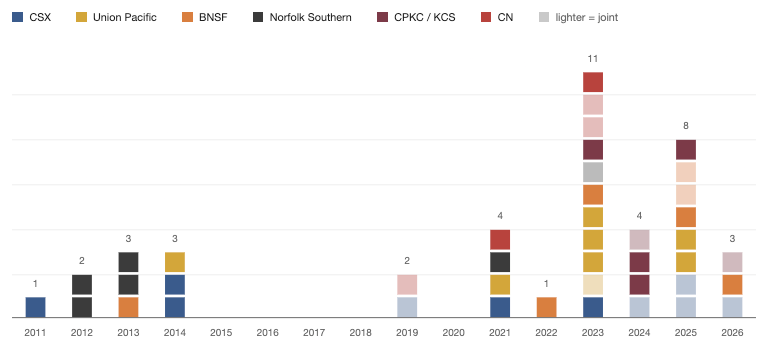
Over the past 15 years, railroads have announced roughly three dozen new services or terminal expansions.
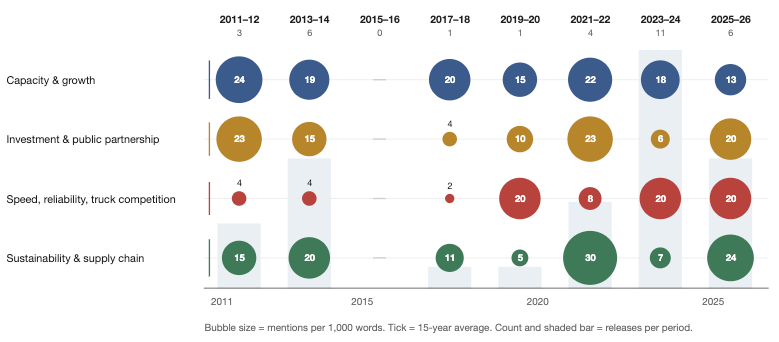
Of course “customers” and “shippers” feature prominently, but there was a noticeable drop in activity between 2015 and 2020, some of which can be attributed to a mismatch between demand for specific services or regions and a downtrend in the availability of government funds (TIGER, CRISI grants). As a result, some railroads pulled their commitment to these new opportunities and began shuttering terminals in 2017, especially as PSR became more prominent. Notice the clear pivot to speed and reliability as more recent themes?
What has become more interesting is BNSF’s long-running commitment to Barstow. Originally announced in 2022, the idea was full of novelty: position lift, storage, and distribution capacity beyond the Inland Empire rather than attempting to create more of it in an environment generally unwilling from a policy standpoint and unable with respect to land availability. BIG is also the most non-obvious of the bunch, in that the development sits literally in the middle of a desert, roughly 130 miles from the metropolitan area it ultimately serves.
Years ago I spent a week viewing the old Santa Fe skyline from the head end of premium Z-trains across BNSF’s southern route. My first thought after arriving Barstow, stepping out of the cab and into a crew van: there is no way it is this hot at midnight. The next morning I was impressed at the sheer size of the place (I had yet to visit Argentine) and the breadth of the facility.
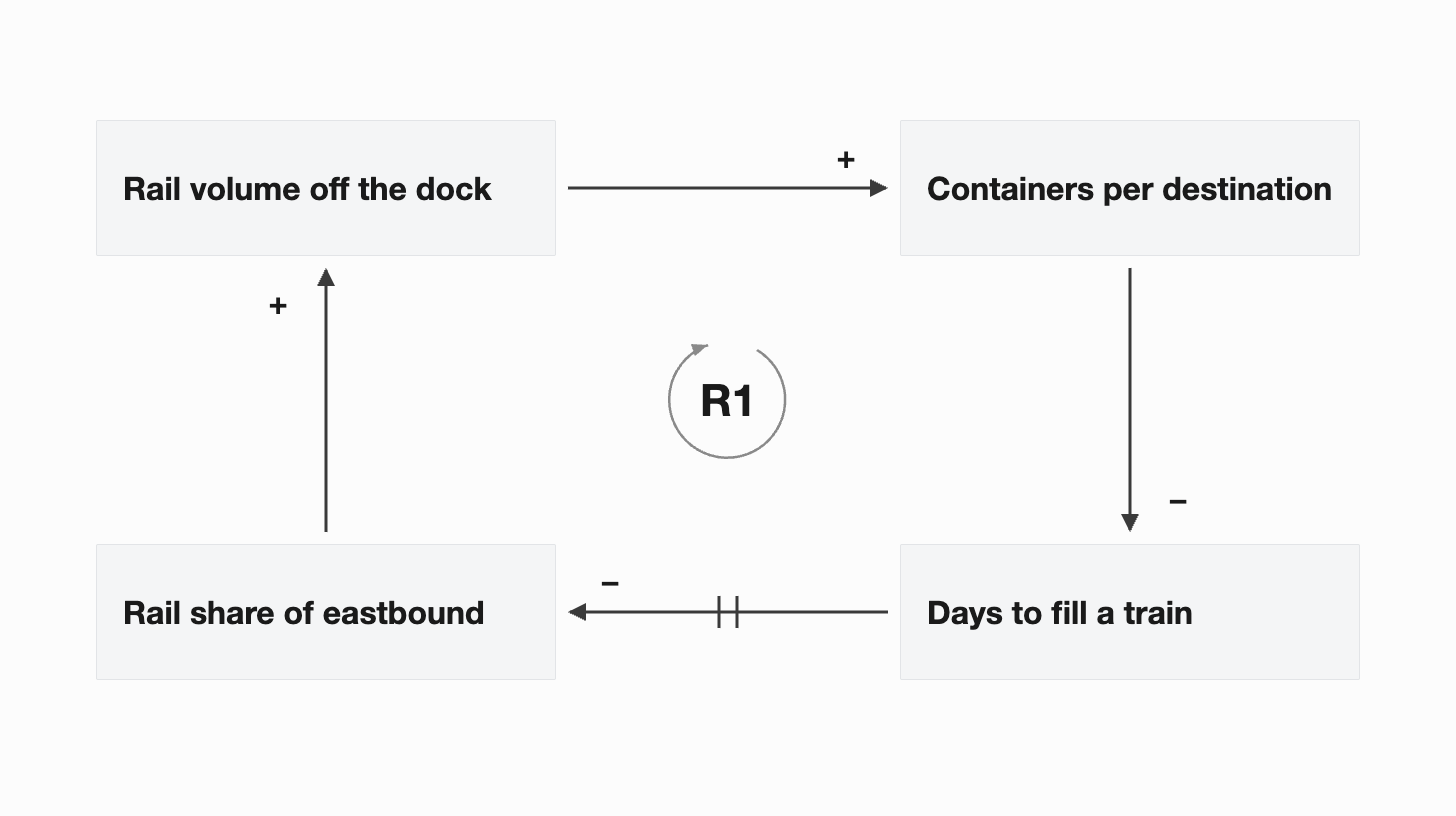
Yet the most interesting part of BIG is not the size of the expansion or the dollar value. It is what BNSF is betting on long term. Ultimately, freight networks - and railroads especially - are dynamic systems subject to supply, demand, routing choices against their own ability to organize, classify, and process volume in the most efficient manner. From my view, the strongest underlying aspect of Barstow from its geography and position is its influence on container utilization, train velocity, drayage optionality, and potentially, autonomous intermodal. With outbound rail container dwell times consistently outpacing outbound truck times in the San Pedro Bay, it is important to view this as a functional bet on the underlying interplay between port <> truck <> rail dynamics and box turn times. It seems that the investment will allow BNSF to bifurcate volume and enhance velocity between: (1) the Inland Empire, (2) large / legacy demand markets, and via BIG, (3) smaller + emerging destinations with less daily container volume. For those interested, here is a link to a basic system dynamics model which helps frame this concept.
Sorting upstream
One of the most effective ways to reduce the number of days it takes to fill a full train is to segment traffic into blocks. Traditionally, a good portion of this block building or setting was completed at or near the port facilities where space is notoriously constrained. Thus, portions or full trains would be broken apart at downstream terminals in a practice known colloquially as block swapping. The logic here is the battle of accumulation versus touchpoints. Ultimately, sorting at Barstow means less sorting downstream at places like Clovis or Fort Madison.
However, despite the recent uptick in volume at the ports, there has been long term pressure on imports which can exacerbate dwell and congestion in the area. For emerging markets: containers are still arriving, just not at the density that fills a block as quickly. So whether the containers dwell longer at the port or the depot or the serving yard, it takes longer to fill a train. This is a factor that continues to plague the transit planning for steamship lines.
Share shift, competition with the Panama Canal
Waterborne transportation, absent barriers and tolls, is effectively frictionless. Containerization produced economies of scale that accrue naturally to open space: large ports, open water, post-Panamax vessels. To compete, a railroad needs throughput and to improve throughput it needs capacity, usually in the form of land, tracks, equipment, and crews.
The canal has been winning that trade for a decade. Twenty years ago Los Angeles and Long Beach handled roughly half of all US container imports. By 2023 it was about a third. The canal expansion made all-water service to the East Coast cost-competitive, and the East Coast is closer to where a significant portion of consumers reside.
Capacity, for BNSF, comes in the form of evacuating the docks and moving lift and block-building capacity inland. Considering Long Beach just posted its busiest August in ~100 years and Los Angeles just closed out its best ~90 day stretch ever, it seems the momentum trade is moving in the right direction.
Serving the Inland Empire from the other side
The counterintuitive move is approaching the Inland Empire from the north rather than from the port. A container for Fontana today comes off the dock, gets drayed up the 710, crosses the basin on the 60 or the 10, and arrives having spent most of its trip in arguably the worst traffic in the country. That same container through Barstow comes down the I-15 out of open desert and deals with noticeably smoother traffic flow. Despite traveling farther in raw mileage, the cargo has spent quite a bit less time dwelling.
When McKinsey diagnosed the congestion plaguing SoCal, the issue was the cascading effect of equipment cycle times and the numerous touchpoints in the drayage lifecycle. As it turns out: terminal appointments, chassis condition, traffic, congested distribution centers, and shippers using boxes as storage lead to significant constraints on capacity. Moving some of the tractor and equipment cycles out of the basin has the potential to benefit some, especially those on the edges of the Inland Empire.
Shorthaul intermodal and the autonomous option
Shorthaul intermodal is great in theory and arduous on the balance sheet. I’ve seen it work in close markets with extreme demand, usually propped up by parcel and package customers, and usually not for long. The unit economics struggle because within a crew district, the cost is fixed per move. Every container pays for a locomotive, a crew, a lift at origin, a lift at destination, and drayage on one or both ends. None of that shrinks as the haul gets shorter.
Depending on who you ask, Barstow is either the best shorthaul candidate in North America or the worst. The 130 miles sit well inside truck-preferred territory. These are also the densest 130 miles of intermodal supply and demand anywhere, running through some of the most congested geography in the country. Which is what makes it the proving ground: if autonomous container transfer works commercially anywhere, it works where the volume is thickest and the alternative is worst. Railroading is sometimes considered akin to an outdoor package sorting system and, if so, this is the best place anyone has to automate the returns.
Ultimately, a good portion of success or failure in supply chain comes down to value capture and surface area. In the physical world, that translates to position and positioning, both of which have always been the long term determinants for railroads. The benefits of the investment in Barstow are not abundantly clear until you evaluate a few layers deeper. One of T.I.’s best lines didn’t show up on an album, it actually came from an interview on seeing the bigger picture:
Fear of failure kills more dreams than failure in it ever did
Note: Huge thanks to Dave Cinotto for always taking the time to explain the bigger “network” plan - for a system and a career. Bear Down!