Resolutions Fade, Resolve Remains

As with every new year, the calendar made its steady march through the first quarter, carrying with it countless good intentions. The beginning of a calendar year is often a period of optimistic resolutions. Aspirations are elevated, energy is fresh, and change is almost as inevitable as the seasons. But intentions waver, momentum is fickle, and results are hard. January often makes promises that April struggles to keep.
Back in January, I shared a note with our team on the differences between setting resolutions and becoming resolute, an idea that success stems less from setting specific goals, and more from embodying daily durable beliefs and habits. In the months since, the world has shifted in ways both profound and subtle. Markets (and balances) have convulsed, plans have evolved into perpetual pivots, and the supply chains are lurching towards a looming cliff in the next few weeks. This is often what makes surfing so challenging: the parts of the wave we can navigate are just a representation of the ocean floor we cannot see with all its uneven steps and ledges.
We tend to make resolutions from the stillness of the shore, or the calmness after the holidays. In fact, roughly 40% of Americans report formally writing down a goal on or around January 1st each year. One of the persistent challenges with resolutions is the curve against commitment: they are largely self-generated, self-monitored, and easily derailed. Based on several studies, adherence rates drop steeply: 75% are still in it after one week, 64% after one month, and just 46% after six months. Candidly, similar patterns often appear in the corporate world, where forecasts and development timelines slip, shift, or evaporate altogether. Does this imply that individuals are wildly undisciplined and organizations are grossly ineffective? Hardly. Nor does the rolling cascade of missed earnings and pulled guidance reflect broad incompetence.
Rather, it underscores a deeper reality: success isn’t always about changing faster than the environment. Sometimes, it is about returning to the principles that do not change at all. Few moments in recent memory underpin this notion than Rory McIlroy’s recent win at The Masters.
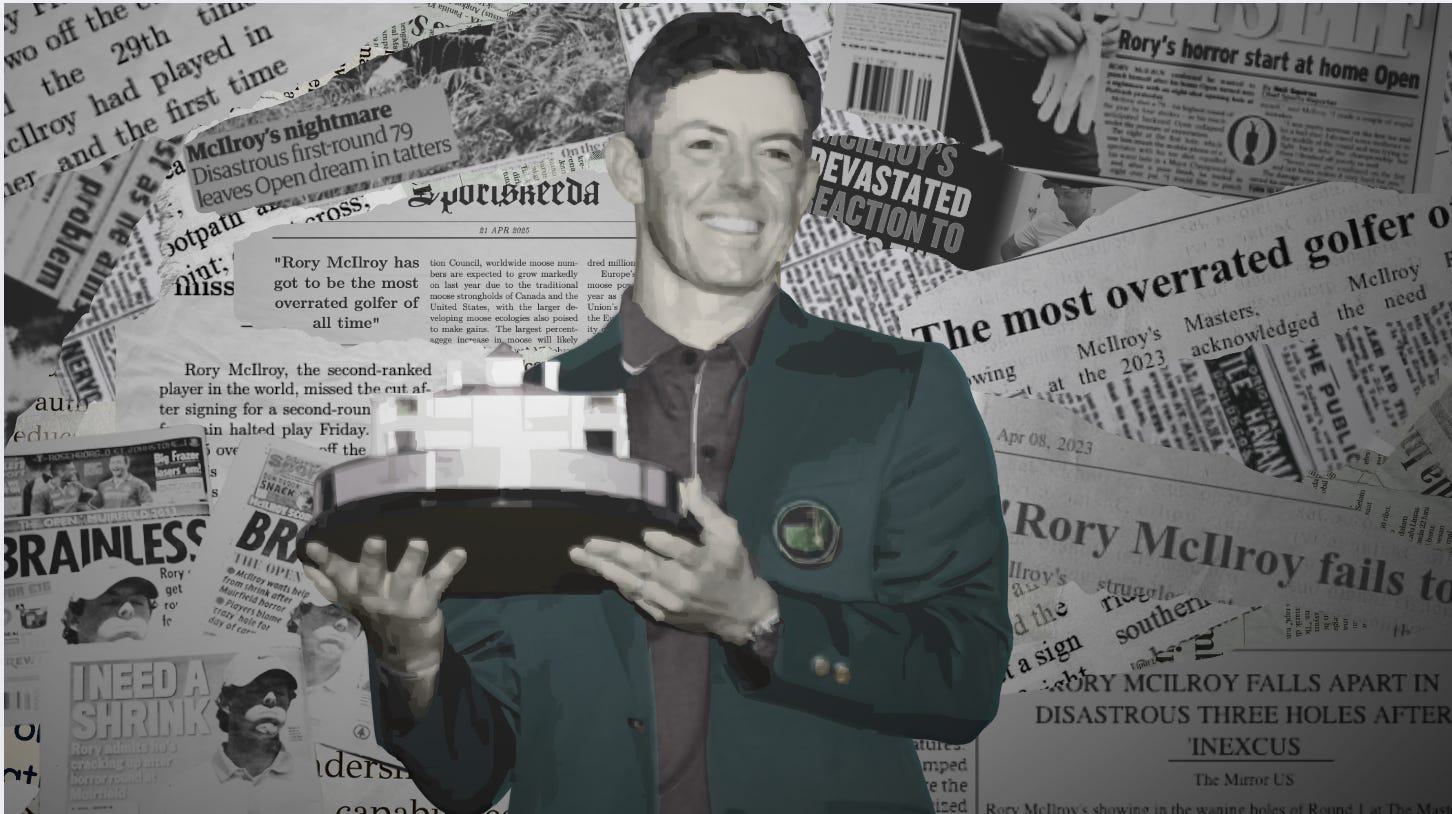
Rors was once the youngest player to become the top golf professional in the world. He also became something of an easy headline, always in contention, but often outside the winner’s circle. In fact, McIlroy is known for:
Collecting four majors before the age of 25; rare air shared only with Jack Nicklaus Tiger Woods
Winning two major championships by eight strokes, setting a record for margin of victory at the 2012 PGA Championship, then..
Going 11 years without a major victory from 2014 to 2025, missing 11 cuts and also delivering 19 top-10 finishes in the same period
After 10 years and 249 days, we witnessed one of the rarest achievements in sports: the compounding interest of steadfast belief. In the 3,899 days since his last major win, McIlroy faced every reason to question his path: new seasons, new critics, even new chapters in his personal life. And yet, beneath the inevitable changes, something deeper endured, the parts of him that never needed reinvention.
Resolutions reflect where we would like to be: aspirations based on outcomes. Being resolute, however, is focusing on daily habits which reflect something deeper: personal values. Resolutions often face structural and psychological barriers - like unrealistic expectations (see: earnings v. tariffs) or societal pressures (see: social media). Being resolute is nothing more than today v. yesterday.
And so, when we feel the unyielding pressure to change, perhaps the better inquiry is not what should adjust, but what should always remain. In reflecting on the potential of the North American rail sector, words like “growth” or "precision" or “efficiency” or “modernization” have grown tired, even hollow. The broader ecosystem, shippers especially, should no longer have to ask: what do I need to believe for this to be true? Rather, and instead, the question should be: what does not need to change in order for this to be true?
A Class I railroad leader once told me, “Service is the price for having a seat at the table.” That has never been more true than it is today. Amid all the headlines about transportation “innovation,” it is stability — not novelty — that matters most in a chaotic market. For all the lore, legacy, and posturing, railroads are, at their core, service businesses. Their essential product is simple: moving goods from one place to another. Their value lies in offering consistent capacity at a remarkably competitive price.
Delivering on that promise does not require becoming a technology company, pursuing vertical integration, or chasing the next grand headline. It does not require conference stages, provocative statements to the Surface Transportation Board, or appearances on CNBC. Much like it wasn’t about swapping a caddie for Rory; it was, and remains, the simple, unglamorous act of persistently swinging the club, or marking the switch list, over and over. Suffice it to say: winning is hard. Just ask the man who spent over a decade chasing greatness. Good things take time. The best things take considerable time. Pronouncements, aspirations, and headlines will come and go. The daily, unyielding effort often goes overlooked until, suddenly, it doesn’t.
Resolutions are bold statements of desire. Resolve is a subtle declaration of identity. Rory’s path back to greatness wasn’t forged by public pronouncements, but by private repetition: swing after swing, day after day. In a market flooded with bold headlines and shifting strategies, the organizations that will endure are those that understand the quiet power of consistency. In life, as in sport, it is not what we announce that defines us. It is what we persist in, long after the applause has faded.