We belong together

More than 30% of American towns owe their location, their shape, or their survival to a railroad. Literally. West of the Mississippi, in some states, the number of rail-centric population centers rises above 70%. The post-Staggers landscape still hums with freight along corridors that were drawn when a surveyor picked the flattest available grade and kept moving. James J. Hill chose Havre, Montana as a Great Northern division point around 1891, and brought together a sizable switchyard, shop complex, and roundhouse. Eventually the town wrapped itself around the railroad’s expansion, where it serves as a major crew change location on the Hi-Line today. It is interesting to think about staying power: decisions made ~130 years ago still determine how freight is routed and where people are located.
As a society, we would be hard pressed to find a musical artist with similar staying power as Mariah Carey. After 30 years, she holds more number one singles than any solo artist in history. Her 2005 hit We Belong Together spent 14 weeks at the top of the Billboard Hot 100 and was later named the song of the decade. Like most songs, it is especially persuasive as one voice with one point of view.
As it turns out, this is true of most debates: they are notoriously single-sided with an attempt at persuasion. Union Pacific’s application to acquire Norfolk Southern runs roughly 7,000 pages. Nearly every one of them makes some version of the same argument. The coalition opposing it – rival railroads, shipper groups, labor – has been equally disciplined in the other direction. Somewhere in between sits a growing pile of artificial commentary, much of it generated faster than anyone could reasonably read. Unfortunately, the topic now looks less like groups engaging in debate and more like individuals reciting (or copying + pasting). Arguing a point is not the same as framing one, and that difference is where the slop grenades are missing the proverbial mark.
As it turns out, history is filled with examples of misdirected excess. The great Roman Senate is filled with examples of orators talking progress to a standstill. As a counterpoint, Cicero had a method for similar issues. In the Tusculan Disputations, he wrote:
...disputing on both sides of the question; not solely from its being the only method of discovering what is probable on every subject, but also because it affords the greatest scope for practising eloquence.”
The implication here is clear: there is no better way to find what is probable than by considering, and articulating, various and differing points of view. Opinions aside, the Surface Transportation Board is required to hear, and weigh, both sides as a matter of procedure. It might benefit everyone to do the same.
Remember when MapQuest made it obvious?
In full transparency, I have rarely supported Union Pacific’s planned acquisition of Norfolk Southern. Many months into the process, I still have many, many unresolved questions: market power, captive shippers moving from two options to one, and whether a combination this size can clear a test that asks it to enhance competition rather than merely preserve it. Yet, those are lingering questions rather than a period at the end of a conclusion. Anyone with more than a minute in the field can unfurl a map, take a look at the various meeting points of either line, and begin to imagine a world relying less on formal interchanges and more on ‘step off, step on’ throughput. It is one of the most operationally obvious opportunities out there.
Combined, Union Pacific and Norfolk Southern would operate over ~50,000 route miles across ~40ish states, reaching roughly ~90 ports. Obviously, and purposefully, the number garners the headline. However, if you begin to step back and consider the inner workings of the entire system one of the biggest operating expenses for the rail network is dwell. Disproportionately, dwell occurs most frequently where two separate carriers must stop and make a custodial transfer of railcars. If you are following the logic, these interchanges occur most frequently in places where eastern and western railroads meet up. A combined network with a meaningful share of traffic could, in theory, reduce the amount of time a carload or intermodal shipment waits for handling.
There are roughly 10,000 origin-and-destination pairs served jointly by Union Pacific and Norfolk Southern today, with between 2,000 and 4,000 unit transfers per day at gateways. If you’ve ever listened to (or participated in!) the multitude of conference calls happening daily between rail lines on the topic of interchanges, you get a sense of how obvious the combination makes from an operational sense. On any given day in Chicago there will be at least fifty calls between yardmasters, briefings between crews, and a countless amount of radio traffic coordinating the moves between carriers. Yards like Proviso, Ashland and Colehour are used to orchestrate these moves. Depending on traffic type, blocking, and volume, interchanges have historically taken days. Much of that dwell is owed to viewing the opposing yard in a region as a sorting facility or, rather, a step in the process rather than a problem to be eliminated.
This is the kind of friction that the likes of UPS, FedEx, and Amazon would have eliminated years ago, given the opportunity. It is also a structural bottleneck that PSR would have addressed, too. This is one of the inherent benefits of the potential acquisition: fewer opposing touchpoints.
The filing implies meaningful network acceleration through the reduction in car handlings. Addition by subtraction, by another name. Whether that translates into transit times customers can feel is a different, and harder, question that the industry avoids at large. However, the logic is sensible and deserves its own exploration.
But the resources do not route themselves
One thing that filings and forecasts - no matter how rigorous - cannot answer: will the right resources be in the right places when the volume ultimately shows up? This is one of the oldest problems in the industry. Historically, the most operationally proficient organizations deployed work retention boards. Now, many make it seem like TY&E hiring is as perpetual as the supposed truck driver shortage.
If railroads are responsible for placing and, in some cases, growing towns where crew changes occur, it is rational to think that the proposed combination has the potential to change the map. Union Pacific’s application abolishes 928 train crew positions and creates 1,698 over three years – a net gain of 770 if the projected growth arrives. To test the promise of the deal, here is a simple model that demonstrates the benefits of growing the human resource pool. Assuming ~2,750 fewer car handlings per day and a dwell reduction of 2.5 hours at the yards which remain plus a 2.5% improvement in train speed, the combined entity should see a nearly 10% gain in velocity within 24 months post integration.
The math is not complicated, which is part of what makes it frustrating: if the merger is successful in generating new volume then the outcome is a net gain for employees and the industry in terms of velocity which should beget volume (and, by virtue, revenue). Thus, if the resources are truly aligned, UP should be able to fully maximize one of its favorite velocity metrics: miles per car, per day.
The question then becomes: can a fixed network business create more throughput by rearranging the flows?
If savings are an obsession, is growth anything more than a fantasy?
Historically speaking, rail combinations are notorious for disruptions in the short term and savings in the long term. The filing builds synergies to $965 million per year by the third year, post transaction. Most of that corporate dream is tied up in personnel rather than velocity or utilization. This is, from a shareholder’s perspective, encouraging in that it doesn’t require better performance or, in financier terminology: underwriting risk. This lines up with prior merger / acquisition performance in that combinations are almost always accretive from the cost perspective, even when the integration is fraught with operational failures. UP’s savings from the SP deal eventually outran the original projections.
For me, the greatest potential with the combination is service. That happens to also be the factor which ultimately decides if any of this produces more growth or just becomes a leaner version of the current map. Savings are easy to model, but cutting your way to growth is nearly impossible especially in a resource intensive operating environment. Thus, the question really becomes: after the inevitable cutover chaos, does the new network produce a system which truly yields more miles per car, per day? If so, then should shippers anticipate material, tangible, and consistent improvements in transit times?
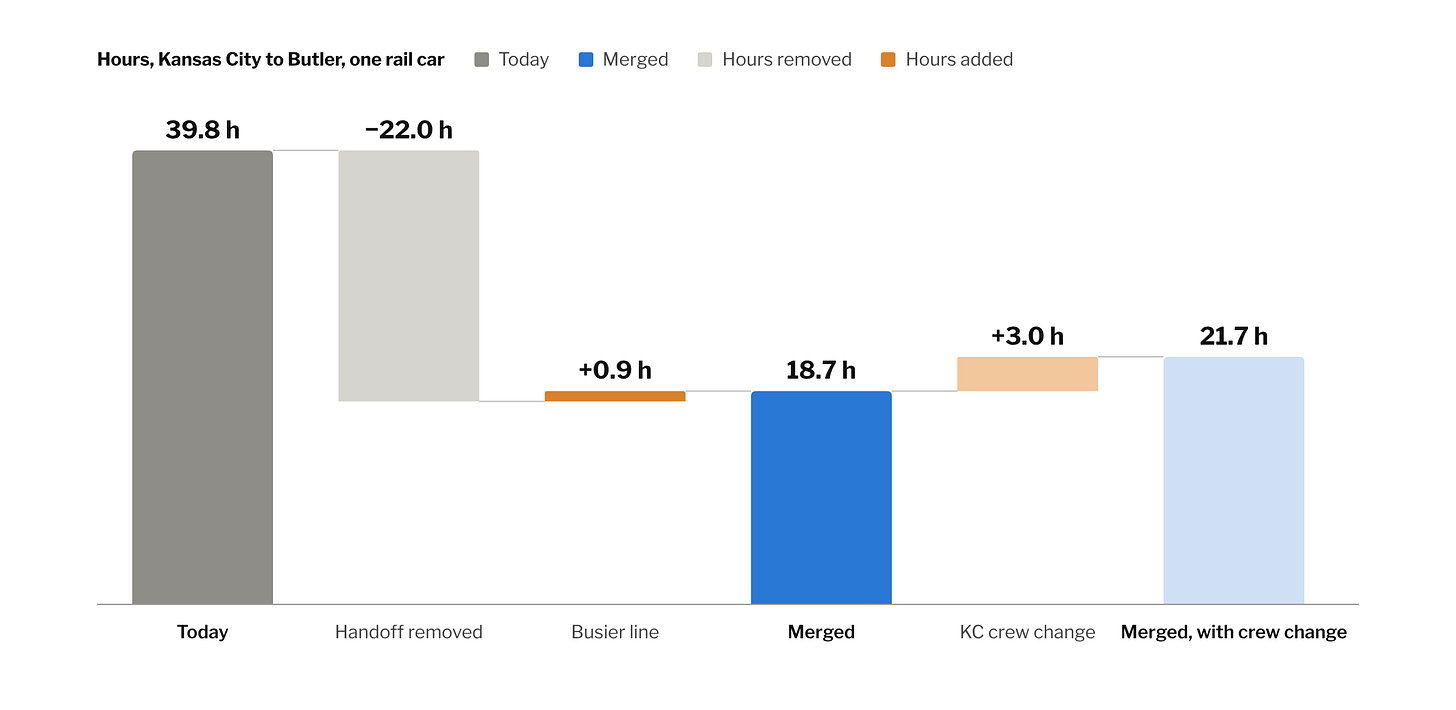
This was a good opportunity to use ALTRIOS, an open-source train simulator which models the physics for real world rail operations (physics, sidings, etc). For meets on single track, the model adds a simple first-come, first-served dispatcher. The roughly 590 miles of mostly single track between Kansas City and Butler was a good candidate as it is scheduled for substantial post-merger improvements that will (1) improve track speed and (2) remove car handling altogether. Assuming 3 more additional eastbound trains (16 total) and the elimination of interchange (22 hours), traffic can move across this segment at double the velocity (15 → 32 mph). Adding back the crew change, fuel, and inspection in KC and the traffic still arrives ~18 hours sooner.
What shippers have needed for a long, long time is a network which performs - consistently - to a higher standard. Absent independent and high conviction increases in capital expenditures across multiple sub-networks, consolidation does present some very unique and interesting upsides from an operational standpoint. Whichever way the decision moves, rail shippers deserve an interconnected network that earns its place in the transportation portfolio.
The circumstances that led to the writing of We Belong Together are not too dissimilar to the drama unfolding in freight rail today. The subtle trick in the song is that it sounds like something more than a programmed drum pattern, a piano, and vocals: it seems like a conversation, but it actually plays more like an echo chamber. The merger discussion is starting to have the same acoustics. If the combination ultimately results in hours of transit time given back to shippers, then who are we to sing against that outcome?